Project Jackfruit

Kampala, Oeganda

Project Jackfruit is an initiative focused on the development and implementation of PrimeJack®, an innovative meat blend in which up to 40% of the meat is replaced by dried jackfruit sourced from Uganda. The jackfruit is grown and processed locally and sustainably.

The main goal is to reduce meat consumption in a way that is accessible to flexitarians, without consumers noticing any difference in taste or texture. The blend is positioned as a healthier alternative without artificial additives, which can be used directly in existing recipes and production lines. Jackfruit was chosen because of its meaty bite and neutral taste, and it contributes to a 90% reduction in CO₂ emissions compared to pure meat. You can read more in the information brochure.

Impact & Return

Impact

  • Ensures 90% lower CO₂ emissions per kilo of blend compared to pure meat.
  • Helps flexitarians reduce their meat intake by up to 40% without loss of flavor.
  • Creates fair and sustainable income for local farmers in Uganda.

Return

  • Annual expected return of 7.4% on your investment.
  • Security & transparency regarding your investment.
  • At the end of the term, both the principal and the interest will be repaid.

Project JACKFRUIT Video

Attractive expected return of 7.4% per year

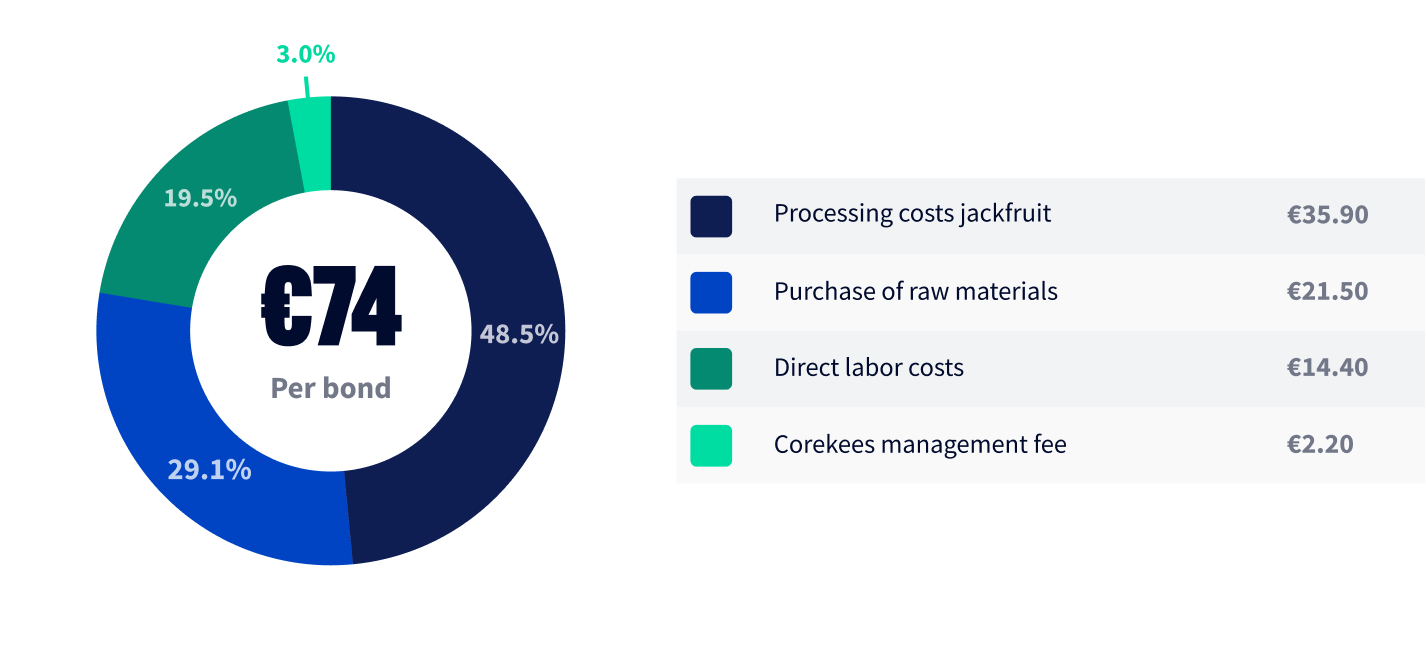
Where does your money go?
HOW PROJECT JACKFRUIT WORKS

step 1

from fruit to fibre

In Uganda, jackfruit is harvested and immediately processed into natural fibre. This is done by thousands of small farmers, who thus gain a more stable market for their produce. The value remains in the region because the processing takes place locally.

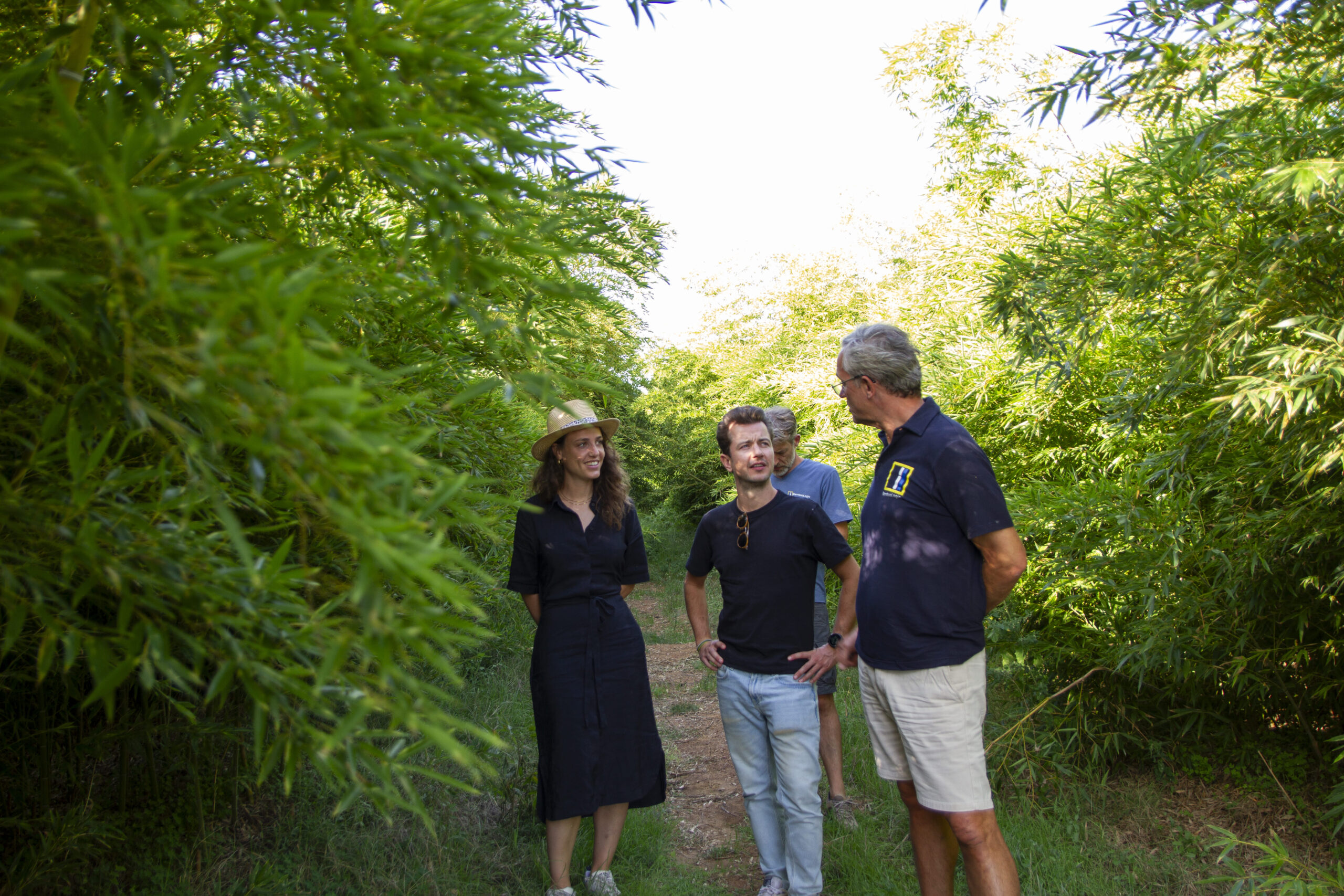
Nick and Thom from Corekees on a site visit in Uganda

Step 2

From fibre to ‘light meat’

The fibre is dried and converted into PrimeJack®, an ingredient that replaces up to 30% of the meat in burgers, snacks and sauces. Producers do not need to change anything — they simply add it to their existing recipe.

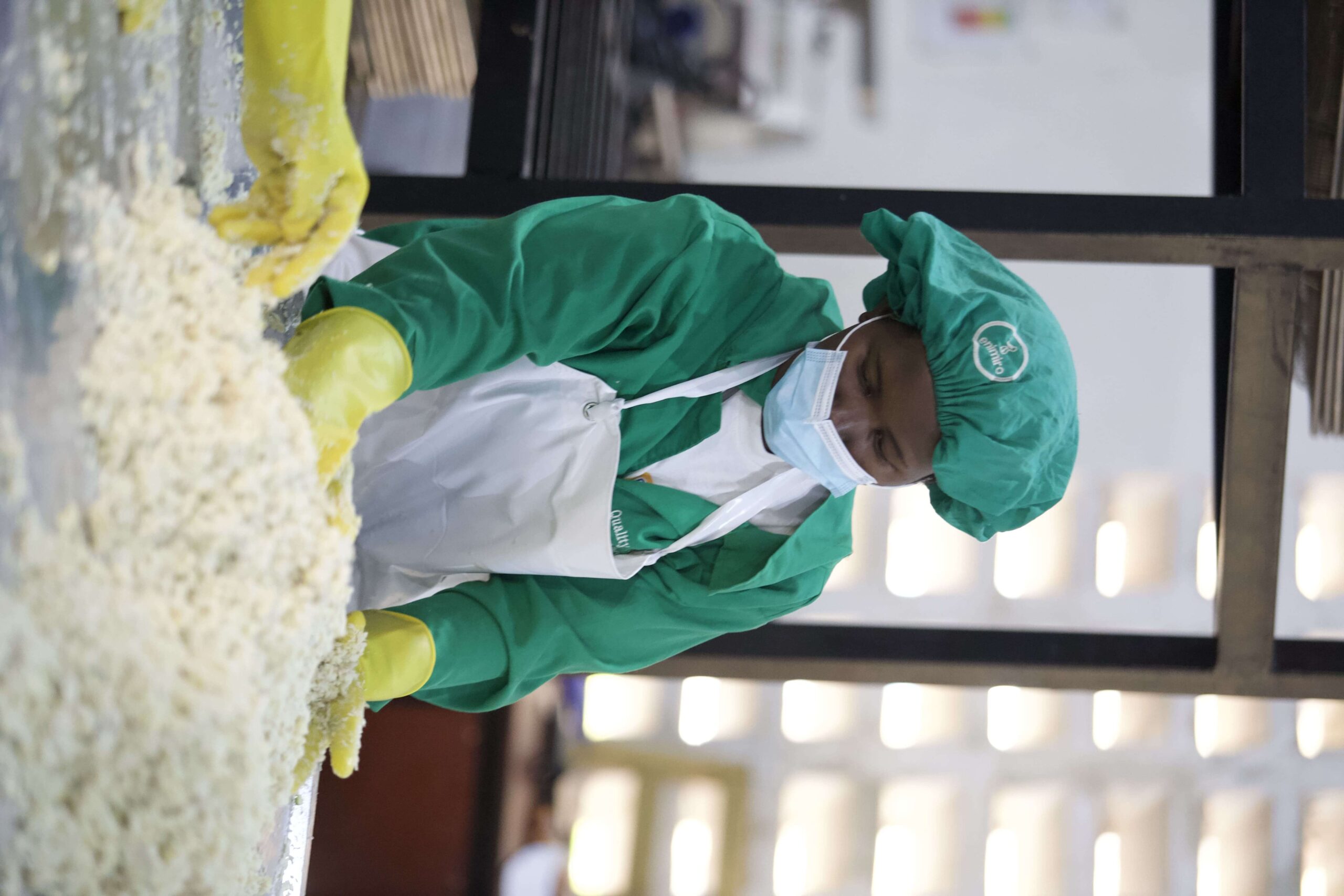
Processing jackfruit fibres

step 3

From sales to return on investment

PrimeJack® is sold to meat processors and food service companies that market blended products. Your loan is repaid from the proceeds of these sales, and you receive an annual return. In this way, you contribute to reducing meat consumption without anyone having to change their eating habits.

The vegetarian McKroket, made with PrimeJack®


News about Project JACKFRUIT

Interview

How jackfruit from Uganda ended up in the McKroket

Project Jackfruit

Ineke Aquarius explains how jackfruit from Uganda makes meat more sustainable and provides farmers with a fair income.

View item

Frequently asked questions

Why is jackfruit sustainable?

Jackfruit is naturally sustainable: it grows in abundance on small-scale farms in East Africa, often alongside other crops such as coffee or spices. Because we only use the residual product – the fruit that would otherwise be lost – we prevent waste. In addition, jackfruit is processed using regenerative agriculture: a method of cultivation that improves the soil, absorbs CO₂ and stimulates biodiversity. In this way, farmers and investors contribute to a healthier food system.

Who buys the jackfruit?

The jackfruit is processed into PrimeJack®, a blend that partially replaces meat in burgers, snacks and other products. Major brands such as McDonald’s and Albert Heijn already use it, and dozens of new products are in development. We mainly supply European producers who want to make their products more sustainable – without compromising on taste or margin. Local processing in Uganda ensures that the added value remains in the region itself.

Who is your local partner?

Our partner is Fiber Foods, a Dutch social agricultural company that works with more than 10,000 small-scale farmers in Uganda, over half of whom are women. They process the jackfruit locally into a long-life ingredient, ready for export. Fiber Foods ensures fair prices, training in the field, and actively works on regenerative cultivation methods. In this way, we create economic opportunities and impact together.

How do we calculate our impact?

The claim of up to 90% fewer emissions* is based on a comparison between traditional meat and jackfruit. Meat emits an average of 24 kg of CO₂ per kilogram (beef, pork, chicken). Jackfruit emits only 0.34 kg of CO₂ per kilogram.

Based on this, 5.6 kg of jackfruit per bond yields an estimated saving of 132 kg of CO₂:
5.6 × (24 – 0.34) = 132 kg of CO₂ per bond.

*Source: Our World in Data**
Source: primejack.com/co2

€240.722
282 Investors
Risk Score Risk Score
Sold out
  • icon–bankcard Created with Sketch. €74 per bond
  • icon–transfer Created with Sketch. ROI: 7,4% / year
  • icon–hourglass Created with Sketch. Term: 3 years
Download information brochure
Status: Op schema

2000+ Corekees investors went before you

Olle de Geest
Rating: 5/5

It's great to invest in a tangible way, make an impact and learn a lot about the projects through regular updates!

Marlena Fishall
Rating: 5/5

Corekees is accessible, which is great. You don't need to be a financial expert or invest a large amount of money to participate. I used to find investing very intimidating and complicated, but with Corekees, it's simple and accessible.

Pieter Brouwer
Rating: 5/5

A very good way to invest easily and sustainably. You can see exactly where the money is going and where the returns are coming from. Highly recommended!

Other projects

Our projects are all different but always have one thing in common: they give sustainability economic value.

View all projects
Available

Project Spices

Granada, Nicaragua
Risk Score Risicoscore
€408.450
  • icon–bankcard Created with Sketch. €100 per bond
  • icon–transfer Created with Sketch. ROI: 7% / year
  • icon–hourglass Created with Sketch. Term: 1 year
View projects
Closed

Project Jackfruit

Kampala, Oeganda
Risk Score Risicoscore
€240.722
  • icon–bankcard Created with Sketch. €74 per bond
  • icon–transfer Created with Sketch. ROI: 7,4% / year
  • icon–hourglass Created with Sketch. Term: 3 years
View projects
Available

Project Bamboo

Santa Marta, Alcoutim, Portugal
Risk Score Risicoscore
€440.872
  • icon–bankcard Created with Sketch. €168 per bond
  • icon–transfer Created with Sketch. ROI: 6,7% / year
  • icon–hourglass Created with Sketch. Term: 15 years
View projects
Available

Project Amazon

Nova Carolina, Brazilië
Risk Score Risicoscore
€507.150
  • icon–bankcard Created with Sketch. €99 per bond
  • icon–transfer Created with Sketch. ROI: 7,3% / year
  • icon–hourglass Created with Sketch. Term: 17 years
View projects
Available

Project Pongamia

Carmelo Peralta, Paraguay
Risk Score Risicoscore
€1.539.148
  • icon–bankcard Created with Sketch. €22.50 per bond
  • icon–transfer Created with Sketch. ROI: 7,8% / year
  • icon–hourglass Created with Sketch. Term: 20 years
View projects
Closed

Project Beehive

Kutus, Kenia
Risk Score Risicoscore
€52.736
  • icon–bankcard Created with Sketch. €103 per bond
  • icon–transfer Created with Sketch. ROI: 103 / year
  • icon–hourglass Created with Sketch. Term: 7 years
View projects
Closed

Project Peatland

Gnarrenburg, Duitsland
Risk Score Risicoscore
€213.749
  • icon–bankcard Created with Sketch. €53 per bond
  • icon–transfer Created with Sketch. ROI: 7,1% / year
  • icon–hourglass Created with Sketch. Term: 5 years
View projects
Closed
Risk Score Risicoscore
€153.985
  • icon–bankcard Created with Sketch. €65 per bond
  • icon–transfer Created with Sketch. ROI: 8,5% / year
  • icon–hourglass Created with Sketch. Term: 5 years
View projects
Closed

Project Coco

Simeulue, Indonesia
Risk Score Risicoscore
€190.300
  • icon–bankcard Created with Sketch. €50 per bond
  • icon–transfer Created with Sketch. ROI: 8,5% / year
  • icon–hourglass Created with Sketch. Term: 10 years
View projects