




5 january 2026, by Thom Sabel
Our Investment & Credit Assessment Process
Before any company is launched on our platform, it goes through a structured, data-driven due diligence process designed to answer three simple questions:
- Can this company realistically grow according to its plans?
- Can it reliably repay its loan?
- Does it create a net positive impact on people and planet?
To do that, we developed a three-score framework that balances financial performance, risk discipline, and impact integrity. Built on established credit analysis methods, internationally recognized impact standards, and independent third-party data.
The Three Scores Behind Every Investment
Every company is assessed across three distinct but equally important dimensions. None of them can be weak — strength in one area never compensates for weakness in another.
1. Feasibility Score
Can the company execute and grow according to plan?
This score looks at whether growth ambitions are backed by reality. We combine historical performance with a forward-looking view on business fundamentals.
We assess, among others:
- Revenue history and revenue growth trends
- Path to profitability and margin development
- Operational efficiency and scalability
- Market size, growth dynamics, and competitive pressure
- Strategic clarity and execution risk
- Team experience and decision-making track record
Each of these are assigned a score, together forming the feasibility score. The result: a clear view on whether growth plans are ambitious but achievable — not just a pitch deck story.
2. Reliability Score
Can the company repay the loan — on time, under real-world conditions?
This score is about downside protection. We focus on the company’s ability to meet its financial obligations across different scenarios.
Key areas include:
- Solvency and liquidity position
- Cash flow strength and stability
- Debt service capacity
- Length of operating history and business maturity
To avoid internal bias, we complement our own analysis with independent external credit risk insights, including data from D&B Altares, giving us an objective view on the company’s financial position within its broader market.
This score ensures that every opportunity on the platform meets a baseline of financial resilience, not just short-term performance.
3. Net Positivity Score
Does this company create more good than harm?
We invest in companies that move beyond “less bad” and actively contribute to a better future.
We developed our own impact model based on best practices from the Global Impact Investing Network (GIIN) and the Operating Principles for Impact Management, translated into a practical scoring framework.
The Net Positivity Score combines three components:
Positive Impact
We measure how the company contributes to the Sustainable Development Goals we actively support:
- SDG 8 – Decent work & inclusive economic growth
- SDG 13 – Climate action
- SDG 15 – Life on land
Negative Impact
We assess potential negative effects using the EU Taxonomy, allowing us to consistently identify, compare, and account for environmental and social risks across sectors.
Examples of negative impacts we assess include:
- Carbon emissions and energy intensity, particularly where reduction pathways are unclear
- Pressure on natural ecosystems, such as land use change or biodiversity loss
- Resource inefficiency, including excessive water use or waste generation
- Supply chain risks, such as labor standards or environmental practices beyond the company’s direct operations
These factors do not automatically disqualify a company. Instead, they are explicitly weighed against positive contributions and adjusted based on how well risks are understood, managed, and reduced over time.
Governance & ESG Maturity
We look at whether the company has credible ESG processes in place — not just policies, but actual systems to improve over time.
The logic is simple but strict:
Positive impact is offset by negative impact and adjusted for ESG governance quality.
The outcome is a single Net Positivity Score.
From Scores to a Final Credit Rating
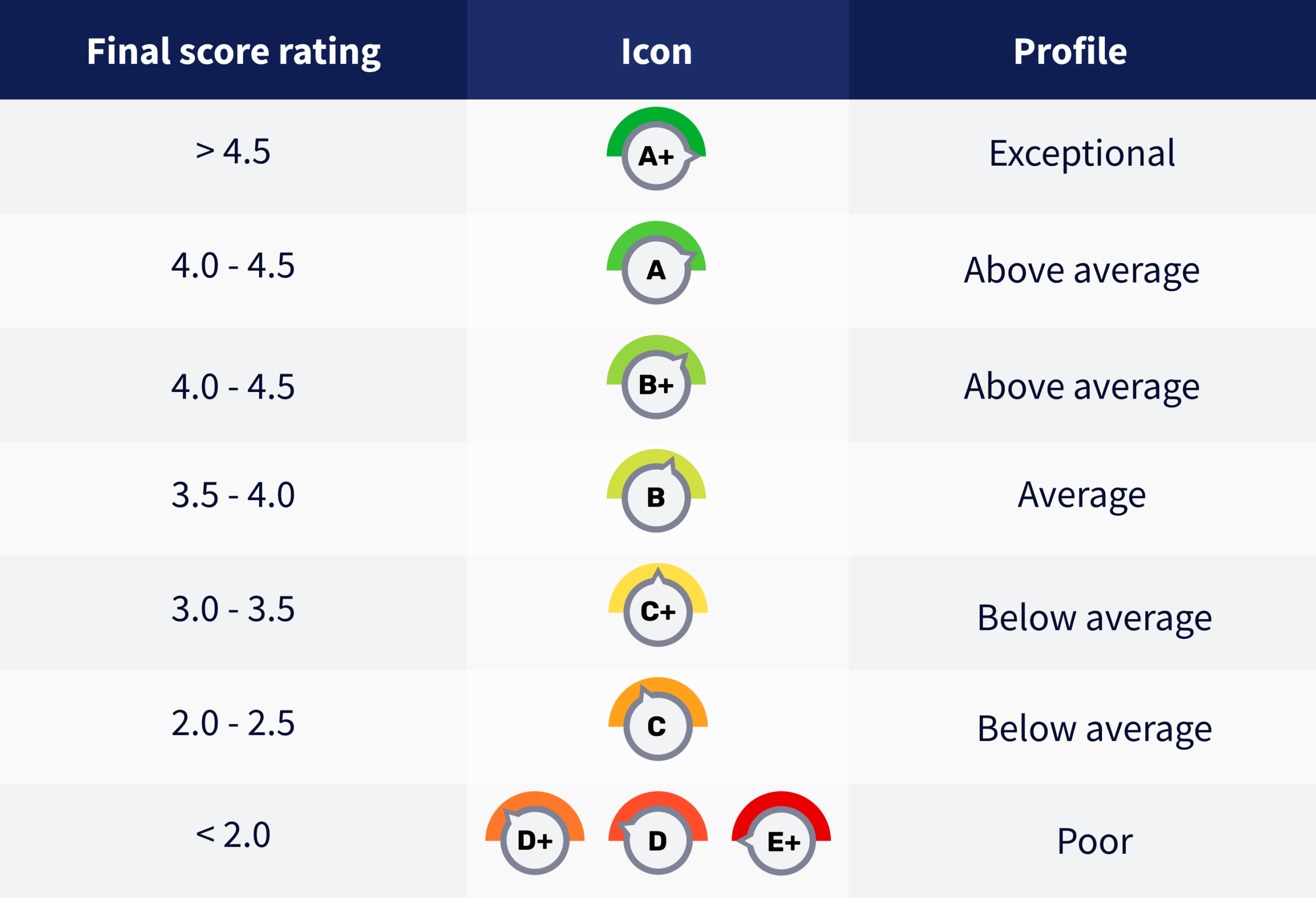
The Feasibility, Reliability, and Net Positivity scores are combined into one final credit score.
Two hard rules apply:
- No individual score can fall below average
- We only invest in companies with an average or above average overall profile
This prevents trade-offs like “great impact but weak finances” or “strong returns but poor responsibility.”
Our Rating Categories
Each investment opportunity receives a clear credit rating so investors can quickly understand the overall risk–return profile.
Always Evolving
Markets change. Standards improve. Data gets better.
Our framework evolves with it — continuously refined to stay aligned with best-in-class impact investing and responsible finance.
Disclaimer
Investors should always consider the specific risks of each investment and use our scores as one of several inputs in their decision-making. All scores are relative and apply only within the context of our platform and investment universe, and should not be compared to credit ratings for other asset classes, such as publicly traded bonds or bank-issued instruments. Our scores and ratings are provided for informational purposes only; no rights can be derived from them, and they do not constitute investment advice, a guarantee of performance, or a prediction of outcomes.

